
Industrial Automation

Industrial IoT, AI and Digital Twins for Intelligent Port Infrastructure

Smart ports for industrial, export and supply chain operations.

Private LoRaWAN networks
IP67, rapid retrofit
99.9%+ uptime SLA

Australian-owned industrial IoT, deployed across critical infrastructure since 2015.

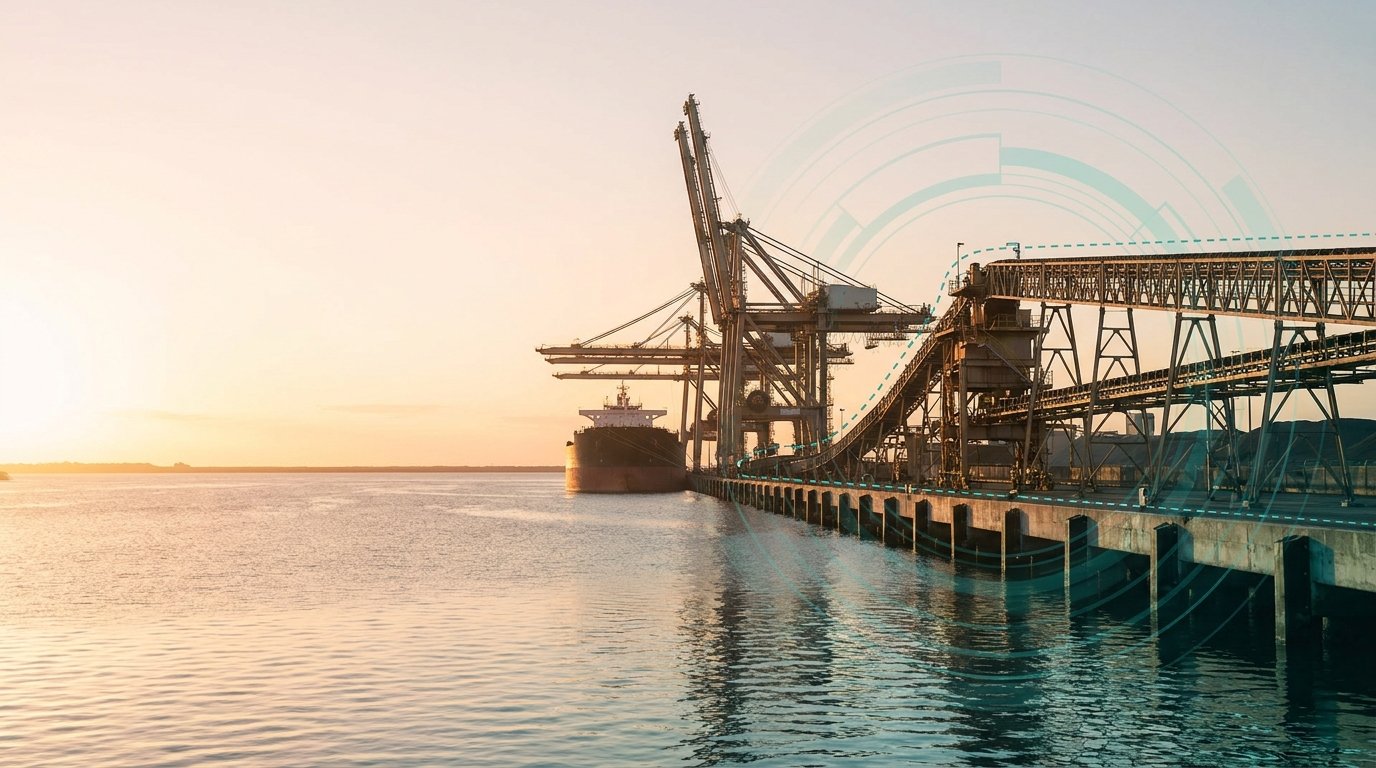
An Australian industrial bulk export terminal at golden hour, ship-to-shore gantry cranes and conveyor gantries along the wharf with a moored bulk carrier, overlaid with a subtle teal data network
The challenge

Critical port assets, running without continuous visibility

Industrial ports are under increasing pressure to move more freight, reduce downtime, improve safety, meet ESG obligations and operate with greater resilience against climate and supply chain disruption. At the same time, many port operators are still relying on fragmented telemetry systems, manual inspections, siloed SCADA environments and reactive maintenance processes.

For maintenance and reliability teams, unplanned failures of conveyors, cranes, pumps, motors, hydraulic systems, rail infrastructure or wharf assets can disrupt production schedules and materially impact export throughput. For environmental and sustainability managers, compliance reporting across water quality, dust, emissions, salinity, energy and coastal conditions often involves disconnected systems and delayed datasets.

Traditional industrial monitoring systems are often expensive to scale, difficult to retrofit and heavily dependent on wired infrastructure. In large operational environments such as ports, terminals, rail corridors and logistics yards, this creates blind spots across critical assets and environmental infrastructure.

A wharf crane fails mid-shift and export throughput stalls.

Corrosion on marine steel runs unseen until the next inspection.

ESG and compliance data arrives weeks late, from disconnected systems.

The cost of inaction includes
Unplanned downtime of mission-critical assets
Reduced berth and logistics efficiency
Increased maintenance costs
Asset fatigue and infrastructure degradation
Compliance and ESG reporting risk
Delayed operational decision-making
Reduced visibility across supply chain operations
Increased exposure to climate and coastal risks
What we do

Real-time intelligence across every port asset

We deliver Industrial IoT, AI-enabled telemetry and digital twin integration for industrial ports, export terminals and supply chain infrastructure. We help port authorities, operations teams and asset managers digitise critical infrastructure using scalable sensing, long-range wireless networking and cloud-connected operational intelligence.

Industrial IoT sensing

Vibration, pressure, corrosion and more, sensed on the asset.

LoRaWAN network deployment

Long-range, low-power coverage across the whole precinct.

Remote telemetry systems

Field readings streamed back from dispersed assets in real time.

Asset condition monitoring

Early warning before a fault stops production.

AI-driven predictive analytics

Forecast failures and the right maintenance window.

GIS and digital twin integration

A live spatial model of the port and its assets.

Environmental monitoring

Dust, salinity, water and air quality across the coast.

Connected asset management

One asset register across the whole operation.

Our solutions provide real-time monitoring of machine health, environmental conditions, utilities and operational assets across complex port environments. Data from thousands of field sensors can be integrated into SCADA, ERP, GIS, digital twin and enterprise asset management systems to support predictive maintenance, lifecycle optimisation and operational resilience.

How it works

From sensor on the asset to decision on the dashboard

Six steps from a field sensor to operational intelligence, built to bolt onto the systems you already run.

1

Asset and Infrastructure Digitisation

Port infrastructure and operational assets are digitised using IoT sensors and telemetry systems, across fixed and mobile assets at terminals, logistics yards, wharves, rail systems and utility infrastructure.

2

LoRaWAN Network Deployment

We deploy industrial-grade LoRaWAN networks using strategically positioned gateways. Long-range line-of-sight and deep penetration mean only a small number of gateways cover large areas. Gateways can be solar, Ethernet, cellular or satellite connected.

3

Real-Time Telemetry and Sensing

Sensors continuously collect vibration, voltage, pressure, corrosion, rail stress, dust, water and tank levels, weather, energy and air and water quality. They are battery or solar powered and install without disrupting production.

4

Cloud Integration and Operational Visibility

Telemetry is securely transmitted into asset management, AVEVA PI, SCADA, GIS, ERP, BI and digital twin platforms, creating a unified operational view across engineering, maintenance, environmental and executive teams.

5

AI and Predictive Analytics

AI and machine learning models predict equipment failure, identify abnormal conditions, forecast maintenance windows, optimise asset lifecycle planning and reduce downtime and congestion, shifting from scheduled to predictive maintenance.

6

Digital Twin and Spatial Intelligence

Digital twins combine IoT telemetry, GIS, SCADA, weather feeds and operational systems into a spatial environment for scenario modelling, asset visualisation, infrastructure fatigue analysis, climate resilience planning and optioneering simulations.

The platform

One operational view, every team working from it

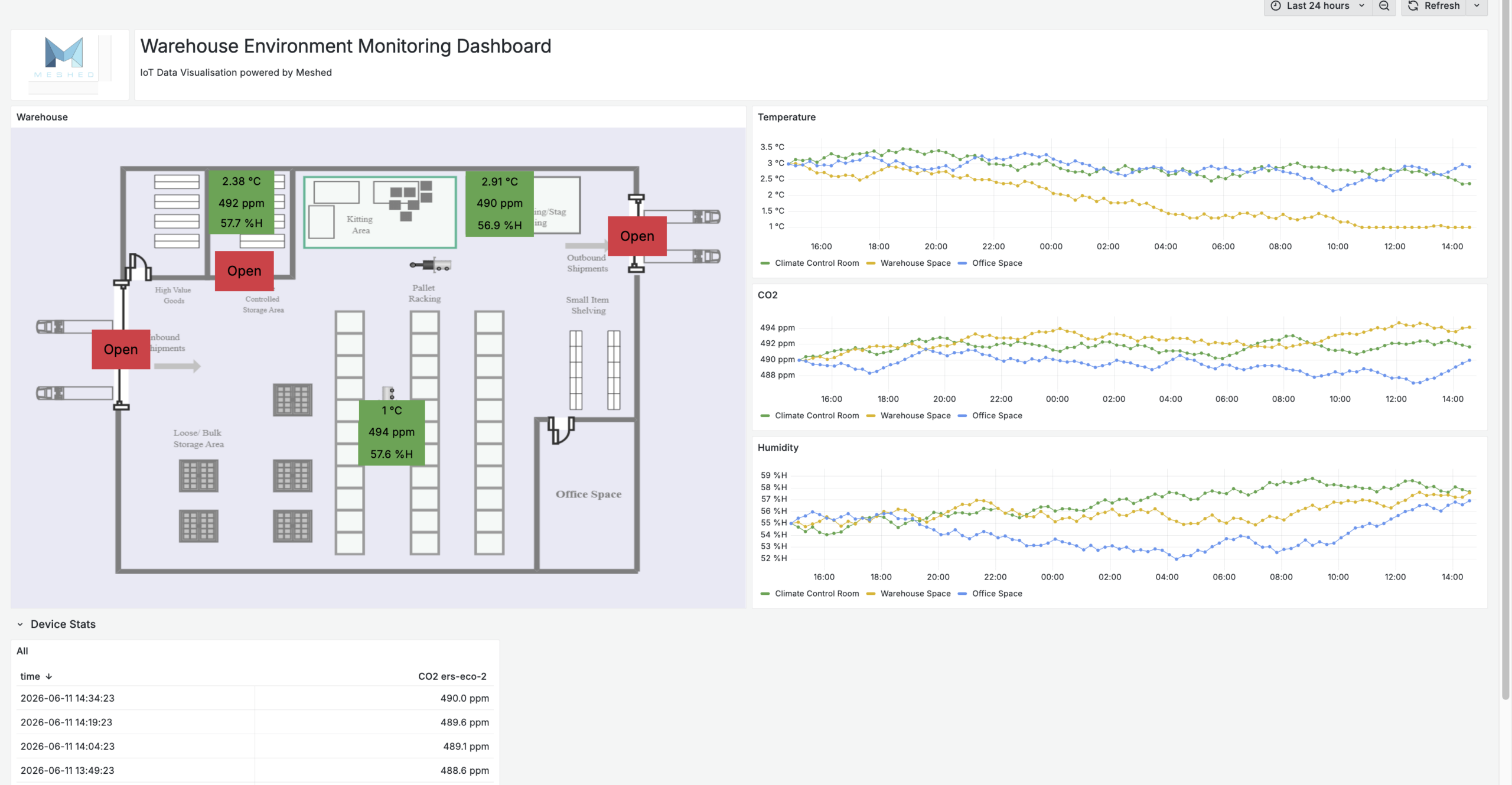
Telemetry is securely transmitted into your asset management, AVEVA PI, SCADA, GIS, ERP, BI and digital twin platforms, creating a unified operational view across engineering, maintenance, environmental and executive teams.

Live environmental and operational telemetry dashboard across a managed facility, the real Meshed platform
Live environmental and operational telemetry across a managed facility, the real platform. (DASH: raw-13 placeholder, honest-fit per D5.)

Built for the scale of a port precinct

3 ports
digitised in one multi-port deployment
99.9%
network uptime on the MeshedX network
10 to 15 yr
sensor battery life on low-power devices

For port authorities, industrial operators, asset managers and logistics leaders who need greater visibility, reliability and operational resilience across complex industrial environments, we are the Industrial IoT and smart infrastructure partner that delivers scalable real-time telemetry, AI-enabled analytics and digital twin integration. Unlike traditional wired SCADA-only approaches or isolated monitoring systems, we provide rapidly deployable, low-power, standards-based sensing infrastructure that integrates across enterprise systems and operational technologies to create a connected, intelligent port ecosystem.

Where we deliver

Measurable value across the port and maritime network

There are many areas where IoT combined with data analytics can support predictive maintenance and environmental compliance for a port and maritime facility.

Conveyor Vibration Monitoring

Continuous vibration sensing for conveyors, motors and drives to detect bearing wear, imbalance and mechanical degradation before catastrophic failure occurs.

Wharf and Jetty Corrosion Monitoring

Real-time corrosion telemetry on coastal structures including cranes, wharves, piers and marine steel infrastructure exposed to saltwater environments.

Rail Track Heat and Stress Monitoring

Monitoring thermal expansion and stress conditions on rail infrastructure servicing bulk commodity and intermodal logistics operations.

Bulk Handling Utility Monitoring

Water, gas and energy metering across terminals, utilities and heavy industrial operations to improve operational efficiency and ESG reporting.

Environmental and Coastal Monitoring

Integrated sensing for tidal levels, salinity, dust, rainfall, wind, noise and air quality supporting environmental compliance and climate resilience planning.

GPS Asset Tracking

Tracking of trucks, loaders, mobile plant, pallets and operational equipment across large industrial precincts and logistics environments.

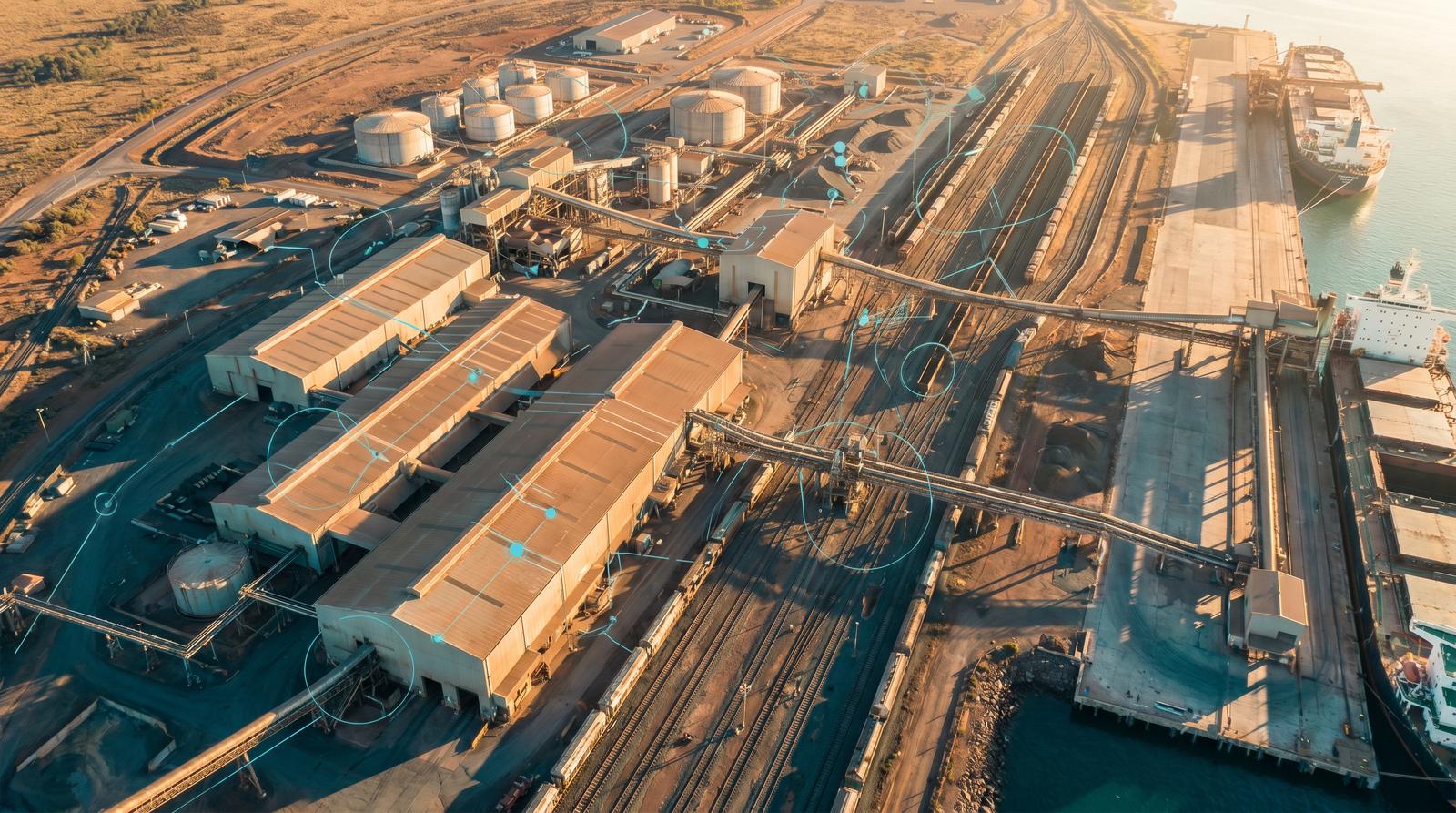
Aerial view of a large Australian industrial port precinct at golden hour, processing plant with wharves and rail lines, overlaid with a restrained teal data network
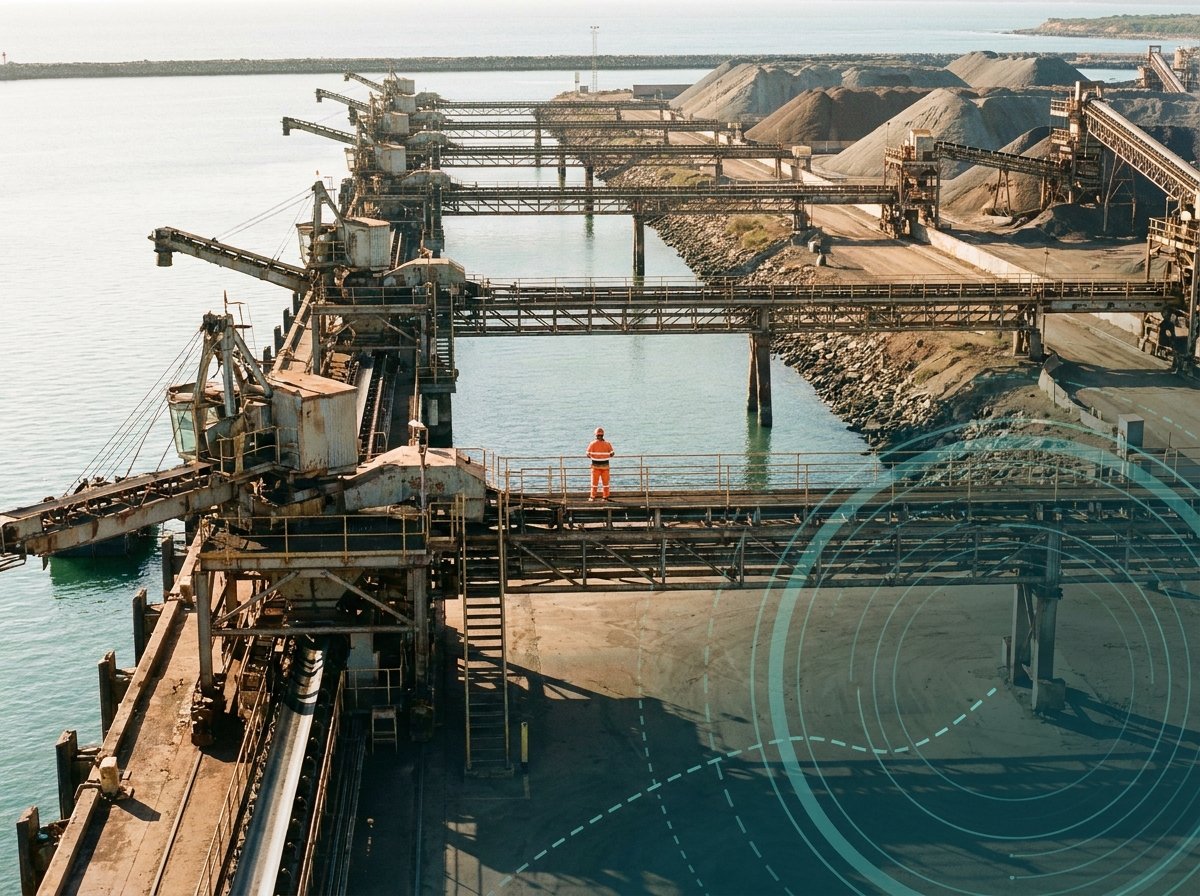
Case study A regional Australian bulk export terminal with multiple berths, ship loaders and conveyor gantries over coastal water, with a faint teal data overlay

From distributed infrastructure to real-time visibility across three ports

Southern Ports, Albany, Bunbury and Esperance. Multi-port industrial and export operations.

Scale

Hundreds of IoT sensors across multiple port facilities.

Challenge

Digitise assets and improve operational visibility across geographically distributed infrastructure.

Solution

LoRaWAN telemetry integrated into an ESRI-based GIS digital twin platform.

Result
  • Real-time asset visibility and predictive analytics
  • Integrated cost modelling and spatial operational intelligence
  • Long-term lifecycle optimisation across distributed ports
  • LoRaWAN telemetry, GIS visualisation and digital twin integration, with drone breakwater and autonomous robotic inspections
Also deployed · Global Steel Manufacturer

Thousands of vibration sensors across Australia, New Zealand and Asia-Pacific, integrated into connected asset management and AVEVA PI systems, supporting early mechanical fault detection across AC/DC motors, hydraulic systems, synchronous drives and autonomous robotics.

The difference

Built for a distributed port, not a single control room

Traditional approach

  • Manual inspections
  • Reactive maintenance
  • Wired infrastructure
  • Isolated SCADA systems
  • Limited environmental visibility
  • Vendor lock-in
  • High deployment cost

The Meshed Smart Port approach

  • 24/7 remote telemetry
  • Predictive and prescriptive maintenance
  • Rapid low-power wireless deployment
  • Integrated enterprise visibility
  • Continuous ESG and environmental telemetry
  • Open standards and API-driven integration
  • Scalable modular architecture

Our solutions are built around interoperable and standards-based technologies including LoRaWAN and global standards, Open Platforms Communications Unified Architecture, API-driven integrations, ISO 55000 aligned asset management principles, and the United Nations Sustainable Development Goals.

The specs

Built on open, industrial-grade infrastructure

Connectivity and Power
Network Technology
LoRaWAN LPWAN.
Communications Backhaul
Ethernet, Cellular, Satellite.
Sensor Power
Battery, Solar, Mains.
Gateway Power
Solar or Mains.
Deployment and Integration
Deployment Type
Rapid retrofit without operational shutdown.
Integration Paths
SCADA, ERP, GIS, BI, AVEVA PI, Asset Management Platforms.
Architecture
Open, modular, API-driven.
Monitoring and Tracking
Asset Monitoring
Vibration, pressure, voltage, corrosion, lubrication.
Environmental Monitoring
Dust, air quality, salinity, rainfall, wind, water levels.
Asset Tracking
GPS tracking for vehicles and mobile equipment.
Intelligence and Security
Digital Twin Support
ESRI GIS, operational spatial twins.
AI Capability
Predictive analytics, failure forecasting, lifecycle optimisation.
Security
SOCI-aligned cybersecurity frameworks.
Questions

Smart ports, answered

The questions port operators ask first. Still sizing your network?

Speak to a Meshed expert
Why are ports adopting Industrial IoT?

Industrial IoT provides real-time operational visibility across critical infrastructure, logistics operations and environmental systems. Port operators use telemetry data to improve reliability, reduce downtime, optimise maintenance schedules and support predictive analytics for operational and asset lifecycle management.

Why is LoRaWAN suited to industrial ports?

LoRaWAN enables long-range, low-power communications across large industrial precincts with minimal infrastructure. Sensors can be battery or solar powered and rapidly installed without extensive cabling, making LoRaWAN ideal for ports, terminals, rail corridors and remote coastal infrastructure.

Can smart port systems integrate with existing SCADA and ERP platforms?

Yes. Modern smart port architectures are designed to integrate with SCADA, ERP, GIS, digital twins, BI systems and enterprise asset management platforms through APIs and interoperable standards. This reduces data silos and improves operational decision-making.

How does AI improve port operations?

AI analyses telemetry and operational datasets to identify abnormal conditions, predict equipment failure, optimise maintenance schedules and improve logistics efficiency. This enables predictive and prescriptive maintenance strategies that reduce unplanned downtime and improve throughput.

What assets can be monitored in a smart port?

Smart Ports can monitor conveyors, cranes, pumps, motors, rail infrastructure, utilities, wharf structures, hydraulic systems, energy systems, environmental assets and mobile equipment using connected telemetry and IoT sensors.

How do digital twins support industrial ports?

Digital twins create a spatial operational model combining telemetry, GIS, SCADA and enterprise data into a single operational environment. Port operators use digital twins for asset visualisation, infrastructure planning, lifecycle optimisation and climate resilience modelling.

How do Smart Ports support ESG and sustainability goals?

Real-time monitoring of energy, water, emissions, dust, salinity and environmental conditions helps ports improve compliance reporting, reduce environmental impact and support decarbonisation initiatives aligned with ESG frameworks and UN Sustainable Development Goals.

What are the key success factors for Smart Port implementation?

Successful Smart Port initiatives require strong data governance, cybersecurity, open standards, enterprise integration, executive sponsorship, workforce readiness and scalable digital infrastructure aligned with operational and environmental objectives.

Validate the use case, then scale across the port

Explore our Industrial IoT Starter Kit and expansive sensor catalogue to kick-start your smart port and operations journey. Begin with a single gateway and a small set of industrial sensors, prove the operational use case, then scale across terminals, rail corridors, wharves and environmental infrastructure.

Explore the Industrial IoT Starter Kit
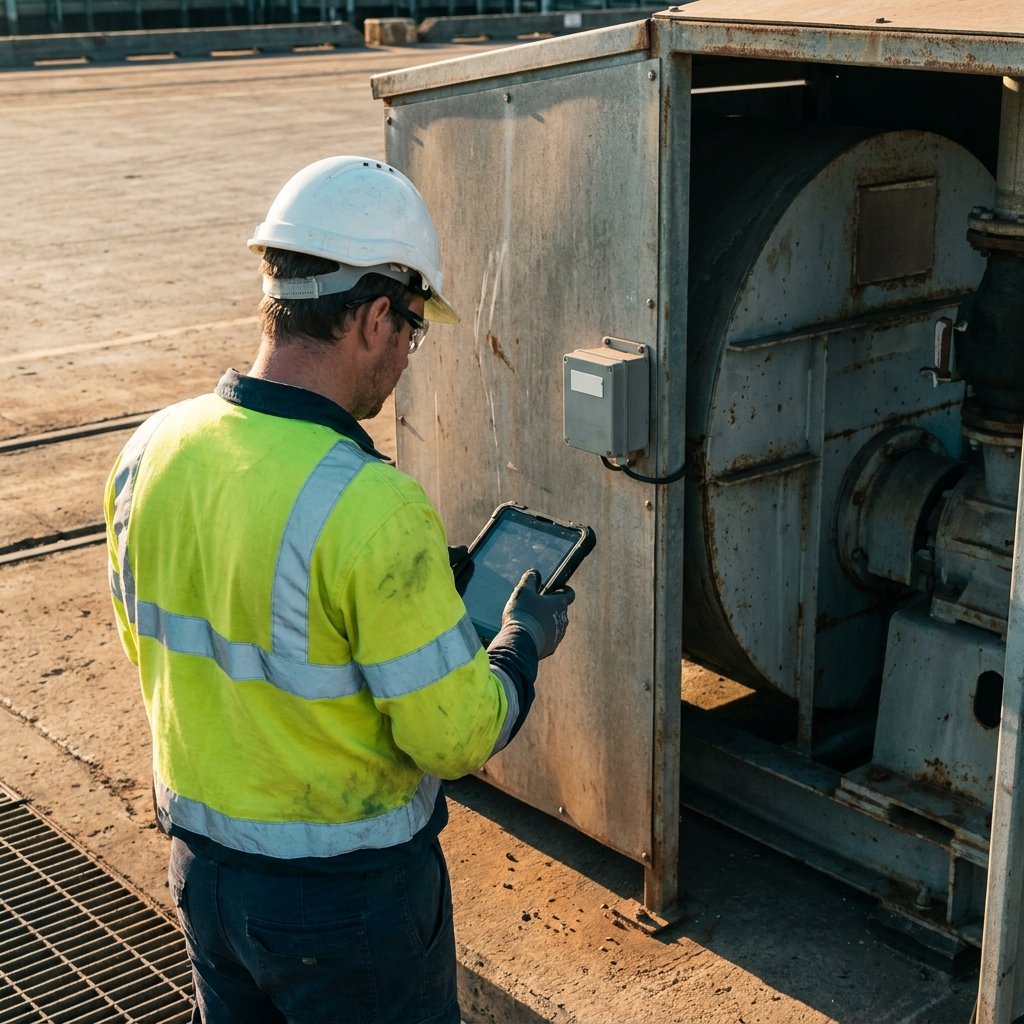
A port maintenance technician in Australian fluoro hi-vis with reflective tape and a hard hat, reviewing a rugged tablet beside fixed wharf plant

Accelerate your Smart Port transformation

Book a Smart Port demonstration with live, real-time operational data, and see what a connected, intelligent port ecosystem looks like at your scale.