Walk through any large mine or manufacturing plant and you will find thousands of motors, pumps, conveyors, fans and compressors keeping production moving. Many are barely monitored, not because the technology does not exist, but because the cost of wired instrumentation has outweighed the perceived value. The useful question is not whether wired or wireless connectivity is better. It is which technology suits the application.
This article compares the two on total cost of ownership, shows where each fits, and explains why wireless has changed the economics of large-scale condition monitoring.
The Right Question Is Not Wired or Wireless
Over the years I have helped organisations connect assets that had never been internet-enabled or integrated into telemetry, unlocking operational insight from infrastructure they already owned. I have also supported the migration of thousands of assets where legacy wired communications had reached end of life, implementing secure, cost-effective wireless that kept sensing, monitoring and control running without replacing existing equipment.
The right choice is rarely about whether wired or wireless is inherently better. It is about selecting the technology that delivers the performance, reliability, security and commercial outcomes the specific application requires.
Different Applications, Different Requirements
Industrial communications are often discussed as though every application has the same requirements. In practice, process control and condition monitoring are fundamentally different engineering challenges.
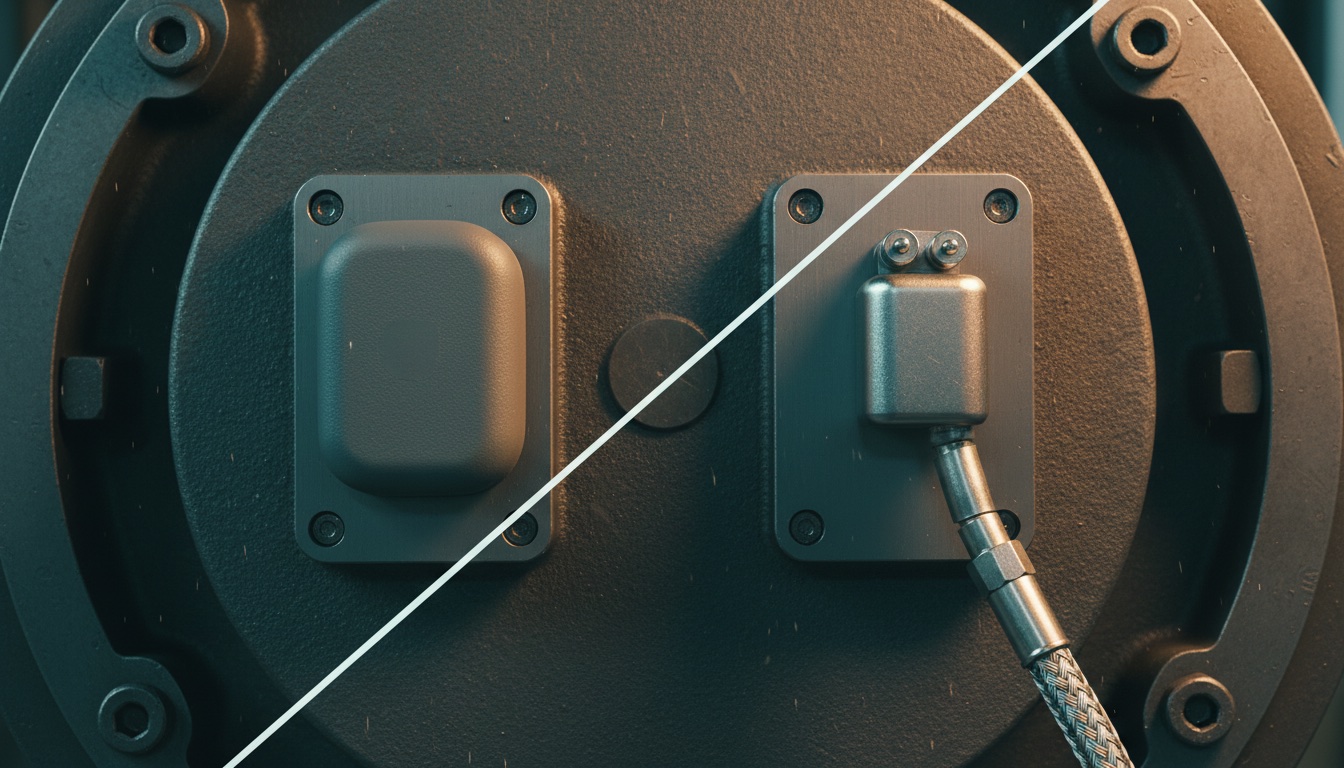
Real-time automation demands deterministic, low-latency communications, which makes wired Industrial Ethernet and fieldbus the preferred solution for PLCs, robotics, safety systems and mission-critical processes. Advanced condition monitoring has different priorities. Collecting vibration, temperature or current data every few minutes does not need millisecond response times. It needs reliable, cost-effective communications that can be deployed at scale.
Looking Beyond Sensor Price
When comparing monitoring solutions it is tempting to focus on the sensor purchase price. In brownfield installations, installation costs frequently exceed the cost of the sensor itself. A more meaningful comparison is the total cost of ownership over the life of the monitoring system.
| Cost element | Wireless monitoring | Wired monitoring |
|---|---|---|
| Sensor hardware | Comparable | Comparable |
| Installation | Low | High |
| Cabling | None | Extensive |
| Specialist electrical labour | Often limited | Usually required |
| Plant shutdown | Usually reduced or avoided | Frequently required |
| Network infrastructure | Gateway, cellular or satellite backhaul | PLC, fieldbus or Ethernet |
| Expansion | Relatively simple and scalable | Complex and costly |
| Ongoing maintenance | Batteries, gateways, antennas and firmware | Cables, connectors, conduit and I/O |
| Asset relocation | Usually straightforward | Rewiring required |
Wired infrastructure remains the preferred choice for many greenfield projects. Retrofitting hundreds of sensors into an existing plant, though, can become technically challenging and financially hard to justify.
Wireless Changes the Economics
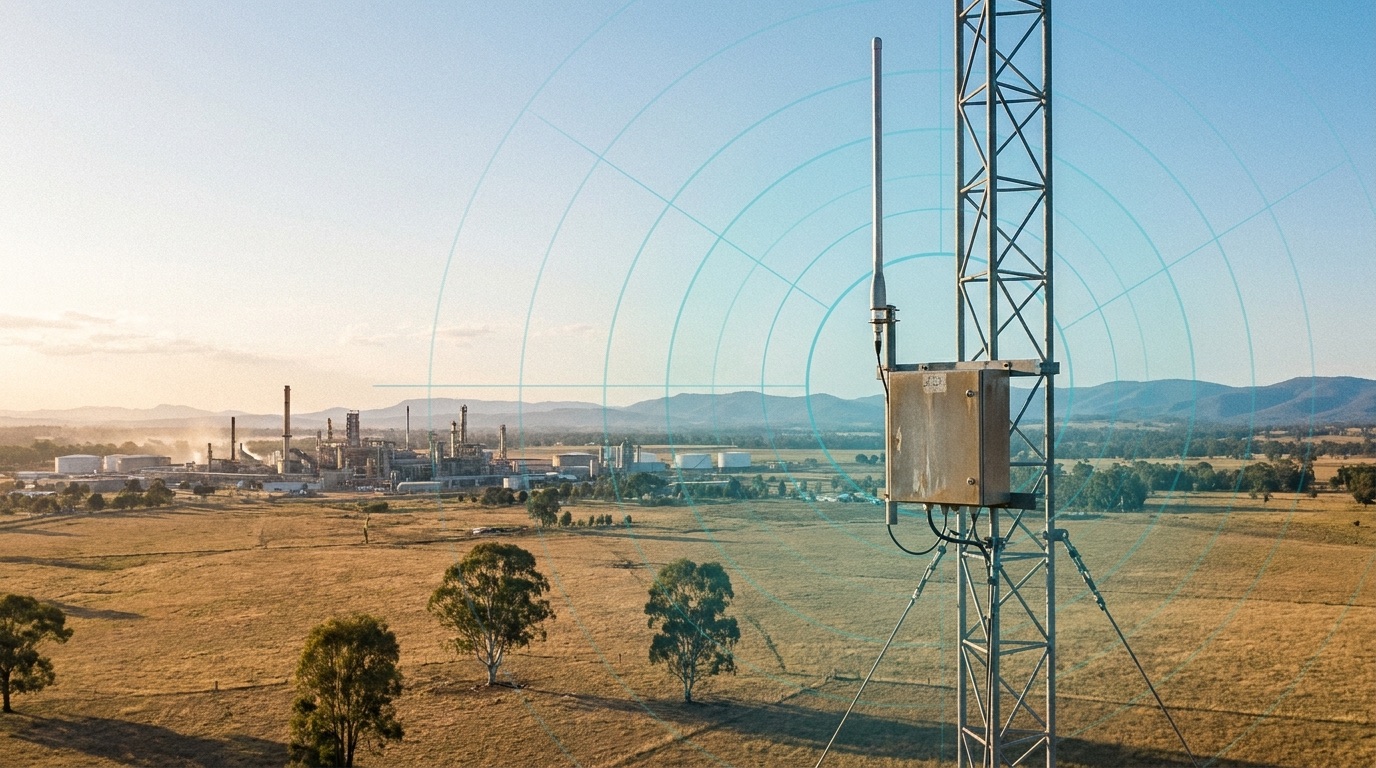
The greatest contribution of wireless industrial IoT is not simply eliminating cables. It changes how many assets can be economically monitored. Maintenance teams used to ask which motors justify permanent monitoring. Technologies such as LoRaWAN make it possible to ask a better question. Why are we not monitoring every critical rotating asset?
Wireless enables broader, more cost-effective monitoring, improving visibility, supporting earlier fault detection and helping teams move from reactive to condition-based and predictive maintenance.
Selecting the Right Connectivity
No single communications technology suits every industrial application. Wireless is not replacing wired infrastructure. It is extending digital visibility beyond the limits of the existing automation network.
| Technology | Best suited for | Typical industrial applications |
|---|---|---|
| Industrial Ethernet and fieldbus | Deterministic, real-time communications | PLCs, robotics, process control, automation and safety systems |
| Bluetooth Low Energy | Short-range, low-power connectivity | Commissioning, handheld diagnostics and local monitoring |
| NB-IoT | Wide-area public cellular connectivity | Utilities, pipelines, water infrastructure and geographically dispersed assets |
| LoRaWAN | Private, long-range, low-power networks | Mining, manufacturing, ports, utilities and large industrial facilities |
A Global Steel Manufacturer at Scale
Consider a global steel manufacturer with operations across Australia, Asia Pacific and the United States. As part of its asset intelligence framework, it set out to improve condition monitoring of rotating equipment across multiple production sites. After a successful pilot of 50 LoRaWAN-enabled vibration sensors, it scaled the solution across its operations. The decision was not a preference for wireless over wired. Despite investment in LTE, Wi-Fi, Bluetooth and other technologies, reliable connectivity at many machine locations had remained a challenge.

LoRaWAN's long range and signal penetration reached areas where other wireless had failed, capturing data from assets that had stayed disconnected. The commercial case was just as strong. Industrial-grade vibration sensors installed in minutes with magnetic or screw mounts, avoiding cabling, conduit and installation work, and multi-year battery life cut installation cost, energy use and ongoing maintenance while giving continuous visibility of critical assets. Wireless was not deployed to replace the wired network or telemetry. It complemented existing infrastructure by connecting assets that were previously uneconomical to monitor.
A Hybrid Future
The future of industrial IoT will not be defined by a single communications technology or sensor type. Wired infrastructure will keep underpinning real-time automation, safety systems and mission-critical process control, while wireless extends monitoring to assets that have been too expensive or impractical to instrument. For mining operations and large manufacturing facilities, LoRaWAN works alongside existing control systems, SCADA networks and traditional telemetry to expand coverage at a fraction of the installed cost of more wired infrastructure. The result is more sensing points, greater data coverage and better economics for large-scale condition monitoring.
This matters more as organisations adopt predictive maintenance and AI. Models are only as good as the data they receive, and wireless sensing makes it practical to collect high-quality condition data from far more assets than traditional approaches allowed. Better data means earlier fault detection, more accurate predictions and greater confidence in maintenance decisions. By integrating wired automation with scalable wireless sensing, organisations improve asset visibility, reduce unplanned downtime and build a smarter, more resilient approach to industrial asset management.